Case Study — 14 / Undergraduate Researcher, L3Harris Technologies HAVLab / 2026–Present
Aquatic Turtle Robot Research
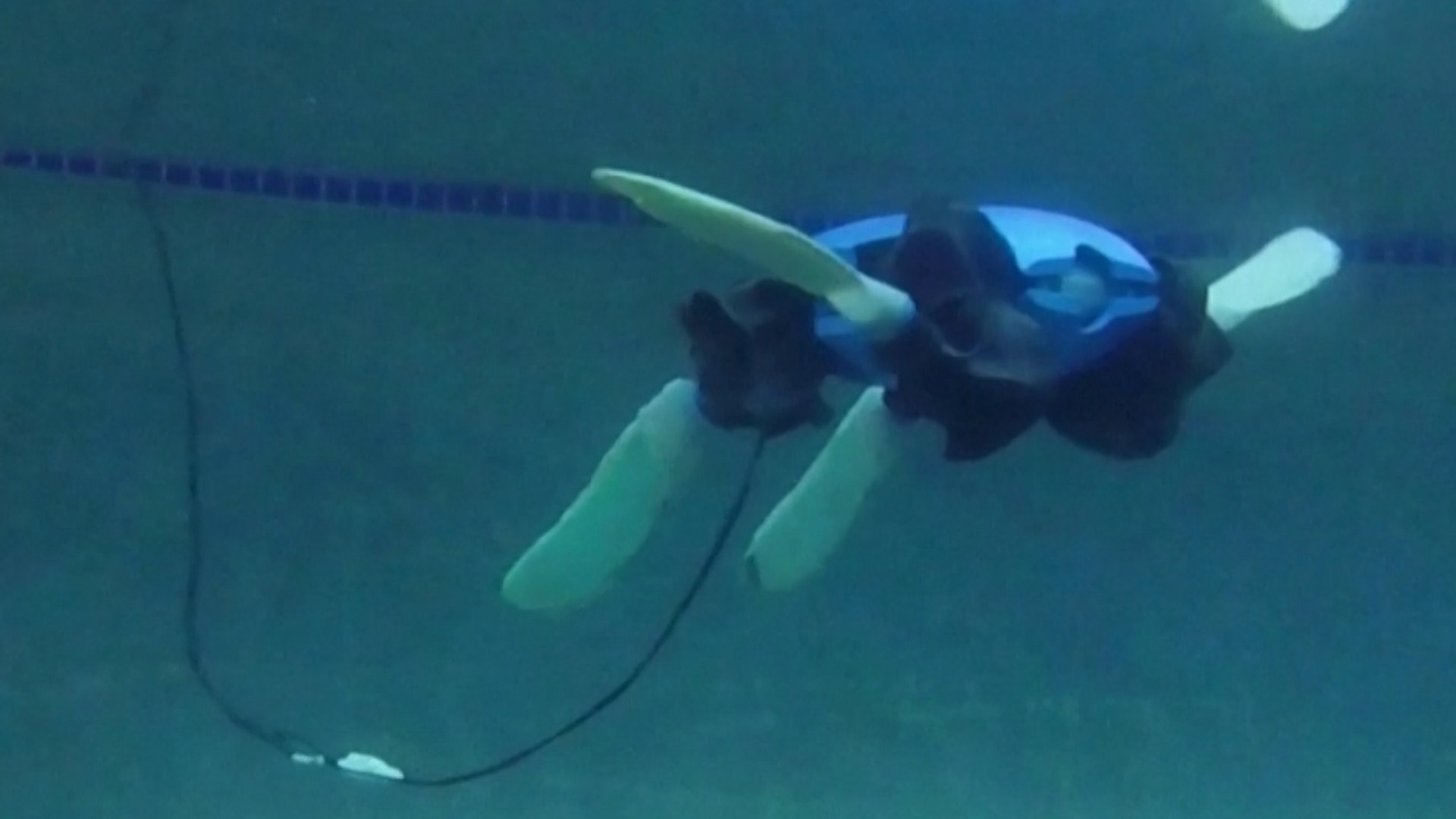
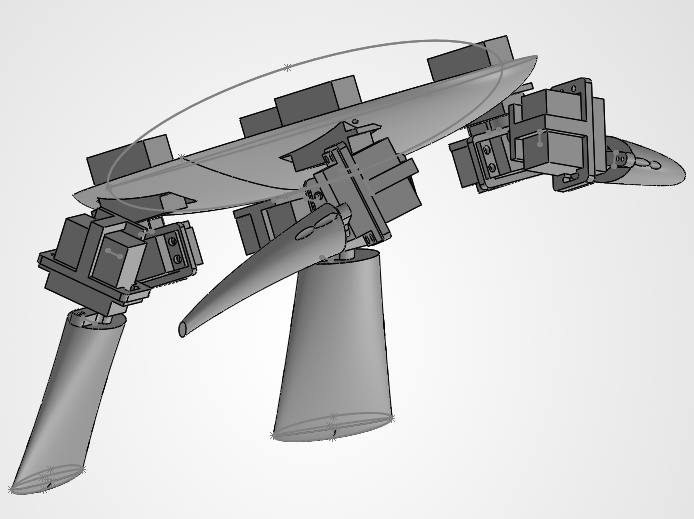
Advancing Yale's published A.R.T. (Aquatic Robotic Turtle) robot toward fully autonomous amphibious locomotion, utilizing simulation, FEA, and advanced control theory.
Conducted rigorous academic research under Dr. Sun in the L3Harris Technologies HAVLab (Hardware Autonomous Vehicles Lab) at Villanova University. This ongoing research project focuses on advancing Yale University's A.R.T (Aquatic Robotic Turtle) which is a highly complex biology inspired amphibious platform. Our primary objective is to transition the robot from teleoperated control to fully autonomous multi-environment locomotion, bridging the fields of hydrodynamics, mechanism design, and autonomous control theory.
• Autonomous Control Architectures: Developing robust state-machines and adaptive gait controllers for seamless transition between underwater swimming and terrestrial locomotion. • Sensor Fusion & State Estimation: Integrating IMU arrays, depth sensors, and computer vision to maintain accurate spatial localization in unstructured, multi-modal environments. • Kinematic Optimization: Utilizing advanced Finite Element Analysis (FEA) to optimize complex leg mechanisms against varying hydrodynamic pressures and terrestrial load profiles. • Simulation-to-Reality: Leveraging NVIDIA Isaac Sim for high-fidelity physics modeling of fluid dynamics and rigid body interactions prior to hardware deployment.
Conducted deep quantitative analysis using Ansys and SolidWorks FEA to validate the structural integrity of the turtle's actuation mechanisms:
• Hydrodynamic Pressure Testing: Simulated deep-water stress distributions to prevent seal failure and mechanical deformation. • Fatigue & Stress Analysis: Identified and redesigned critical stress concentrators within the actuator linkages. • Material Optimization: Conducted trade studies on material yield strength versus buoyancy to optimize the robot's mass-displacement ratio.
Developing autonomy for an amphibious robot requires solving unique, non-linear challenges:
• Buoyancy and Attitude Control: Maintaining 6-DOF stability amidst fluid perturbations and shifting centers of mass. • The Transition Problem: Formulating continuous control policies that can gracefully handle the sudden change in friction, drag, and gravity during the water-to-land boundary transition. • Exteroceptive Perception: Filtering out acoustic noise and optical distortion intrinsic to aquatic environments for reliable obstacle avoidance.
This research role involves rigorous literature review, experimental design, and empirical validation in collaboration with L3Harris industry experts. It demonstrates a capacity for research in bio-inspired robotics, non-linear control systems, and complex mechatronic design.
Next Project — 04