Case Study — 12 / Research Lead / 2023
Triboelectric Kinetic Energy Harvesting

Authored a comprehensive technical proposal on integrating Triboelectric Nanogenerators (TENGs) into urban infrastructure for high-efficiency kinetic energy harvesting.
Led a research initiative to evaluate kinetic energy conversion methodologies. Authored a 60-page quantitative proposal analyzing Electromagnetic Induction, Piezoceramics, and Triboelectric Nanogenerators (TENGs). Designed a conceptual weatherproof module utilizing Plasma Polymer Fluorocarbon (PPFC) and KAPTON films to exploit contact electrification, theoretically capable of generating 6000W from urban foot traffic. Demonstrates strong capability in scientific research, materials evaluation, and technical writing.
Our research evaluated three distinct mechanisms for converting kinetic to electrical energy:
• Electromagnetic Induction: Similar to existing commercial approaches (e.g., Pavegen). Rejected due to prohibitive material costs ($60+/tile), required vertical displacement causing tripping hazards, and vulnerability to environmental degradation. • Piezoceramics: Characterized by a limited yield of ~3.04W per tile. Rejected due to the excessive volume of active layers required and brittle failure modes under continuous cyclic loading. • Triboelectric Nanogenerators (TENGs): Selected as the optimal architecture. Leveraging the triboelectric effect between PPFC and KAPTON films, this design requires minimal vertical displacement (optimizing pedestrian safety). Calculations indicate a theoretical output of ~6000W per module—approximately 2000x the volumetric power density of piezoceramic materials.
The proposed module is a highly integrated, hermetically sealed unit requiring only ~2cm of vertical clearance beneath existing pavers. System components include:
• Enclosure: Rigid polymer top/bottom plates encapsulated by a flexible elastomeric weather seal. • Active Dielectrics: Plasma Polymer Fluorocarbon Film (PPFC) and KAPTON utilized for optimal charge generation. • Charge Harvesting: Conductive aluminum plates capture induced surface charges, feeding a local 4000 mAh lithium-ion storage cell. • Mechanics: Precisely tuned compression springs control the charge separation distance to maximize potential energy generation. • Modular Interconnectivity: Spring-loaded, weather-sealed edge connectors enable a scalable, fault-tolerant power grid.
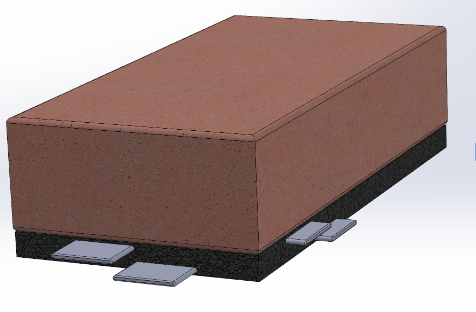
To demonstrate commercial viability, the system was theoretically mapped onto Villanova University's high-traffic campus center (the "Oreo"). The module was dimensionally customized (4" x 8") to serve as a direct drop-in replacement beneath the site's ~10,000 standard "wishbone" pattern pavers, transforming a passive hardscape into a massive, invisible renewable energy array.
• Cost Optimization: Utilizing inexpensive baseline materials (aluminum, commercial plastics, PPFC), the design targets an installation premium of merely $2-$3 per square foot. This vastly undercutting incumbent commercial solutions ($75-$160 per tile). • Environmental Integration: Generates decentralized renewable energy utilizing existing urban footprints, eliminating the ecological disruption associated with sprawling solar or wind installations. • Ubiquitous Scalability: By adjusting geometric dimensions and spring constants, the core triboelectric architecture can scale from pedestrian walkways to highway infrastructure.
Next Project — 13